
Category Archives: Jain Philosophy

Lower Your Himsa Footprint

This thoughtful post is contributed by Mahersh Shah and the Jain Vegans Team, which moderates a web forum that is separate and complementary to this blog. I (drJina) was struck by the appropriateness of the term himsa footprint when I saw this term discussed in the web forum, and Mahersh graciously agreed to write more about it for our blog. Here’s his piece:

Most of us are familiar with the current-day concepts of “eco-footprint” and “carbon footprint” – these terms and concepts have become part of our everyday vocabulary and thought processes.Today, we are being encouraged to reduce our carbon footprints (to help slow down, if not reverse, human-induced global warming and climate change), and to minimise our eco-footprints in a bid to reduce our destructive impact on the environment.

At a Young Jains UK event in  Feb 2008 that started as a conversation about why a vegan rather than vegetarian diet would be consistent with Jain values with  keynote speaker and longtime US based vegan Saurabh Dalal,  the term himsa footprint spontaneously emerged.  The group that was to become the Jain Vegans team  discussed ahimsa and eco-footprints as a reason for going vegan.  Very soon, Kewal Shah shouted out the phrase himsa footprint as it simply appeared in his mind, and the Jain vegans have been using it extensively since.

So how does the term himsa footprint help us?  Well, the beauty of this neat and powerful expression is that it speaks volumes.  To me, when we talk about “lowering our himsa footprints”, we are speaking in a holistic sense, covering the direct and indirect himsa inflicted, by our actions, on all life around us. And by extension, this includes himsa on the environment, since harming or destroying life damages the environment, and damaging the environment harms or destroys life.  Thus, to me, the general concept of himsa footprint covers the more specific concepts of eco-footprint and carbon-footprint, for example, as well as many others.
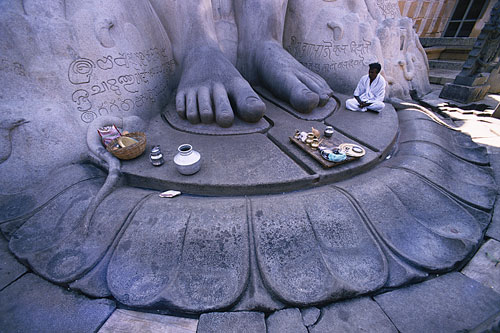
Jains have a long and prominent tradition of embracing ahimsa (non-violence, compassion, peace).  In fact, the concept of ahimsa is at the very core of the Jain lifestyle.  For Jains, and others who believe in karma, practicing ahimsa is also a way of developing spiritually and purifying one’s atma (soul).  Therefore, lowering one’s himsa footprint would be an important activity for a Jain from a karmic standpoint too.  But even if one doesn’t believe in karma, leading life so as to consciously reduce one’s himsa footprint would surely bring about positive inner development, as well as benefiting all life and the environment around us.

Perhaps if we all begin to think in holistic terms of consciously and actively reducing our himsa footprints, then we’ll see many of the global issues facing us today being addressed in one go (e.g. human-induced climate change and other environmental issues).  Indeed, if most human societies, policy-makers and governments around the world started thinking in terms of himsa footprints, then we might even see a dramatic reduction in human-human conflict, bloodshed, war, abuses of human rights and animal rights, poverty, starvation and so on.

Continue reading

A Diwali gift from PCRM: Vegan Kickstart for India!

OK, PCRM didn’t really time this for Diwali, our holiday celebrating the Nirvana of Mahavir Swami Tirthankar this Wednesday. But how nice that we have a 21 day program complete with Indian menus and a Kickstart program set for early November! Spread the word and check it out here.

Dr. Barnard gave a very nice, positive talk at JAINA last July which we have been meaning to post up.  One point that he made very well is how tastes can change;  many of the uncles and antis could identify with the way they are now able to enjoy fat free or low fat milk, when they used to like only full fat milk; similarly, tastes can change to enjoy even healthier soy, almond, rice and other types of non-dairy milks.

For those who follow a traditional Jain diet, the recipes on the Kickstart menu can be easily modified to eliminate root vegetables.  Just remember the 5 sensed beings that are harmed in our traditional dairy based diet and consider all the compassion you are showing by sparing the cows that suffering!

Happy Diwali, may the light of knowledge guide us towards enlightened action.

Prof Gary Francione’s talk at JAINA 2011

Here are the links for the first few segments of Prof. Francione’s discussion of veganism and ahimsa at JAINA.
Part 1

Part 2

Part 3

Join the Jains going Vegan this Paryushan!

I caught up with an old friend a few days ago about an initiative in my city to block backyard slaughter of animals ( that post will go up next). In the course of our conversation, he told me he has made a tradition of going vegan during paryushan. And that’s how a number of people got started on their vegan diets…

Sagar posts on the Jain Vegan list-serv:

Please consider giving up dairy products this Paryushana
As most of you will know, Paryushana, the Jain festival of penance and forgiveness is due to begin at the end of August.

During this festival, members of the Jain faith traditionally fast and participate in pratikraman. For lay members, fasting often entails avoiding activities that are traditionally thought to cause more himsa than others, such as eating root vegetables.
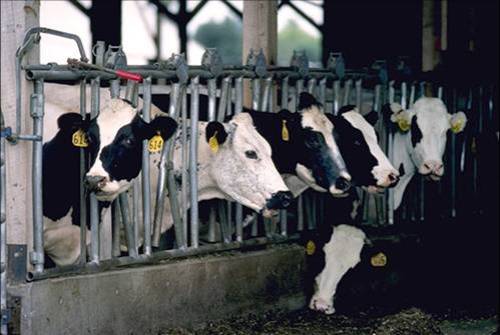
In today’s complex society, the process of milk production causes far more suffering and killing than first meets the eye. Dairy cows are forcefully impregnated by means of artificial insemination to stimulate milk production.

They are immediately separated from their offspring at birth.  Male calves are killed within hours of birth or sold on to be reared for veal or beef (they are of no other value to a dairy farmer), and their sisters are forced to go through the same agony and suffering as their mothers.
A dairy cow will normally get killed before the age of 10, even though she could live up to 30 years if given the chance.  This is because her milk yield drops after about 5 lactations, and it is not does not make financial sense for a farmer to keep her alive when he is able to obtain milk from her younger (and more productive) daughters.

[My addition to Sagar’s post, with the photo above is to show how they are treated like machines. It is also easy to see how infections, such as mastitis, are likely to develop in these mama cows, adding to their suffering].
It is an unfortunate truth that our consumption of milk and dairy products contributes to the killing and suffering cows. In light of this, it seems natural that Jains (and all adherents of Ahimsa) should acknowledge and consider the suffering caused to cows in the milk production when undertaking pratikramana.
So, in addition to the other activities you undertake this Paryushana, why not also consider giving up dairy products?

For hints and tips on how to avoid dairy products, beyond the resources on this site, you are invited to  e-mail sagar@jainvegans.org and/or visit the Vegan Society website.

Ahimsak Diet

Dr Jina gave a talk at the 11th anniversary of the Jain Center of Northern California on the Ahimsak Diet. The slides are available here:Ahimsak Diet and Nutrition and you can see the talk at the following YouTube links:

part 1: http://www.youtube.com/watch?v=sHcnDkswFpQ
part 2: http://www.youtube.com/watch?v=tMFK-ZcGDfo
part 3: http://www.youtube.com/watch?v=VTzTK6ua0b8

For those who are interested in preventing diabetes by choosing healthy Indian foods, Asha Jain has provided some recommendations :

carbohydrate & Caloric Content of common Indian foods-JAIN 2011

Role_of_Food_in_Diabetes_Management (1)

The Birth of the Spiritual Leader Who Gave us Ahimsa

By Gary L. Francione,
Distinguished Professor of Law
 & Nicholas deB. Katzenbach Scholar of Law & Philosophy
Rutgers University School of Law

Although many are aware of the Buddha or the deities of Hinduism, few know anything about Mahavir (599-527 BCE), whose birth the Jain community around the world celebrates on [and around] April 16. This celebration is known as Mahavir Jayanti.
Jainism, along with Hinduism and Buddhism, are the three primary spiritual traditions of India, and archeological evidence indicates that although Mahavir was a contemporary of the Buddha, Jainism predated Mahavir by hundreds of years and, therefore, is the oldest religion in India.  Mahavir is considered to be the last in a line of what the Jains call “Tirthankaras,” which literally means “maker of a ford” and refers to a human being who achieves omniscience and then teaches the path to liberation to others, thereby establishing a ford across the river of rebirth.
A Tirthankara is also referred to as a “Jina,” which means “spiritual victor,” or as an “Arihant,” which means “destroyer of enemies.”  A Jina or Arihant is a victor or destroyer in that he or she has conquered inner emotions and passions, and has complete equanimity that is characterized by an absence of attachment and aversion.  
Mahavir was a social revolutionary.  He rejected the caste system and the sexism that pervaded the society of his time (and that unfortunately persists), and promoted a radical social justice movement based on complete equality and equal inherent value.  He did not limit this revolution to humans and was the first historical figure to regard all nonhuman animals as full members of the moral community. 

Continue reading

Reflections on our actions

Here is a thoughtful prayer that Monali had written for Paryushan, but which can be appropriate for every day, too:

In the fast pace of our lives, may we all take time out today
to recognize how our actions and lifestyles
directly or indirectly cause harm.

From the relative peace we experience and the wealth we possess
From the clothes we wear
to the cars we drive
to the foods we eat
the daily sustenance of our lives undoubtedly causes suffering to other lives around us-whether it be human, non-human animal, plant or other.

As much as is in our power, may we be conscious of this suffering,
and may our actions relflect our desire to prevent or minimize it.
And as for the suffering that occurs of which we are not aware
or that we cannot prevent,may we, at least, recognize it and be humbled.
Micchami Dukkadam.

Vegan Jain Professional and Mom on the radio

Monali and her husband are both busy professionals raising 3 young children near Chicago. She grew up Jain and met him while they were studying environmental engineering . Like me, she became vegan  in college, seeing the connections between the violence in the egg and dairy industry  with that in the meat industry.  She saw that consumption of these animal products was  incompatible with her values of peace and non-violence, which were deeply held Jain values. Her husband went vegan too, the way they are raising their young children vegan is joyful and inspiring.

She was recently interviewed by James Bean of Spiritual Awakenings Radio, who is clearly well informed about Jainism and in tune with the spiritual basis of veganism from the perspective of many faiths . You’ll hear their thoughtful discussion about how people identify with their diets, what might help people to make positive changes and more! You can download an mp3 file of the interview  here.

Request for all vegan menu for the 16th Biennial JAINA convention

Yesterday, i sent a letter to the Convention Board members and the JAINA Executive Committee on behalf of a group of vegan Jain organizers, ranging in age from the 20s to the 70s, and an even larger and more diverse group of supporters consisting of leaders in the Jain community and community members from all across the US with a couple of participants from UK and Mumbai.  We continue to update the list of supporters and have gotten 9 more since yesterday!

Read the text of the petition and register your support here:

Our request: An all vegan menu at the convention.

The precedent: Catering for the London Young Jains Convention  has always been vegan and a recent JAINS UK convention has had all but 2 items catered completely vegan.

 The North American Jain convention history: Vegan lines (an option to eat vegan) an JAINA, YJP and YJP conventions for many years> the exact start is murky but maybe 1997. A good start but we can do better. Continue reading

Former JAINA president advocates clear view of veganism

Dilip Shah is a past president of JAINA, the federation of Jain organizations in North America. Because he is  a generation older than me, in keeping with Indian culture, I call him Dilip uncle.  Among his many other Jain activities, he has organized several trips to India to visit temples and historical sites,  as modern day pilgrimages for Jains in North America.

In 1998, fresh out of my family medicine residency with a couple of months off from work, I took a JAINA organized trip to the famous temple complex Sammet Shikar. I was  accompanied by my parents, my friends Hema and Manda who teach Nonviolent Communication, our family friend Pravin uncle, who heads the JAINA Education committee,  and a large group of people a generation older than me. I learned a lot about traditional ways of worship and travelling in India from them all.  I  and Pravin uncle were the only vegans on the trip. 

Since then, there has been more interest in veganism. The largest change has been among the Jains in their 20s, as evidenced by the demand for vegan food at conventions of Young Jains of America (YJA), and also, to some extent in their 30s and 40s and older. Incidentally, the Young Jains convention in the UK had all Jain vegan food in 1998 — the Brits were way ahead of us, as I don’t think we’ve yet had one JAINA convention with all vegan food.

Pravin uncle has incorporated more and more about veganism in his writings, in addition to his initial article about his visit to a dairy farm and how much of a difference going vegan has made in his cholesterol levels. But the older the Jain, it seems, the less receptive s/he has been to change.  It is in this context that Dilip uncle has written this excellect piece on Jainism and veganism.  Continue reading