Category Archives: Activism

Guide to surviving India as a Vegan

This is a guest post by Sunny Jain an MBA Candidate who is a leader in US Young Jain Professionals

I’ve heard the story one too many times of my vegan friends abandoning their diet while visiting India either due to misinformation or perceived difficulty. Some would say it’s too difficult and would rather just enjoy food there, and others falsely believe that the dairy industry in India is humane (would be interested in educating you if you’re one of those people spreading fake news).

Before my trip to India, I decided that I would be the one to break this mold and wouldn’t give in like everyone else does, and I readied my battle armor as I boarded my flight.

10 days in, I found being vegan in India extremely reasonable and not as awful as I originally thought it would be. In addition to eating lavishly and trying almost any and every street food I laid my eyes on, I had the opportunity to attend Mumbai’s first and largest vegan food festival.

Here are a few tips I want to share with those who plan to remain vegan while in India:

Dealing with Aunties and Uncles

  • Don’t hesitate to speak up and tell them in advance what you can and can’t eat. To them, it’s like some unusual variation of the Jain diet that they may not entirely comprehend
  • Aunties are notorious for being pushy and persistent when it comes to eating home-cooked food, but they’ll respect your dietary restrictions without question (at the end of the day, you’re the guest and they want to cater to you!)
  • Just say: “no doodh (milk) and no ghee (butter)”
    • By default, food labeled “vegetarian” in India doesn’t have eggs in it, so it’s just a matter of avoiding butter and milk

The Plane Ride to India

  • When purchasing to your flight, you’ll have an option to request a vegan meal. Depending on the airlines, you may have to do some digging and click the “Extras” tab to select a special meal type, ask for VGML, this is an international airline code for vegan meals.
  • Important: You must request a vegan meal 24 hours in advance before the flight or you will be out of luck
    • If that happens, just let the flight attendant know (they’re usually super accommodating and will find something for you – even if it’s as little as providing you with snacks and fruits/vegetables during the flight)
  • The vegan meal I received was delicious: quinoa rice with tofu and red sauce, a fruit cup, salad with vegan ranch dressing, bread, and vegan butter
    • It was so fire that I took a photo of it just to share on social media
  • If you’re able to survive the first connecting flight, the airport in Amsterdam has great vegan options

Soy Milk (“Soya Milk” in India)

  • The first thing you’ll want to do when you reach in India is get a hold of soy milk wherever you’re staying
    • This is important because you’re going to be offered chai multiple times a day so it’s good to let them know in advance to make it with soy milk
  • One option is to either ask your family in India to get some in advance before you arrive, or you can buy some yourself
  • Soy milk is very accessible and readily available
    • Can be found at almost any decently big grocery store. If you can’t find it at a location, just walk next door because all the grocery stores tend to be next door to each other
    • I found regular unsweetened soy milk, chocolate soy milk, hazelnut milk, and rice milk
    • When converted to USD, you’ll spend about 6 bucks a box
  • I would recommend getting a few extra boxes to last your time there. Vegan milk doesn’t spoil so it makes sense to stock up
  • SoFit Soya Milk is a famous Indian soymilk brand endorsed by John Abraham

Pau Bhaji

  • Pau Bhaji is a staple street food you’re going to want to indulge in. However, it’s usually served drowning in butter
    • I watched in disgust as a street vendor tossed entire slabs of butter (un-human amounts) into the Pau Bhaji, and used another slab of butter to wipe down with pau
    • There’s legit more butter swimming in it than actual bhaji
  • Fortunately, there’s an easy workaround which will allow you to enjoy street Pau Bhaji without the animal cruelty. It is completely acceptable to demand Pau Bhaji with no butter (remember: they’re catering to you, not vice versa). Tell them what you want, and 9 times out of 10 they’ll deliver
  • In their continuous process of making and replenishing bhaji, they’ll just serve you bhaji from the batch they cook before adding butter. This goes for pau as well.

Indian McDonald’s and Burger King

  • Request any veggie burger or wrap and subtract the cheese and mayonnaise
  • I would choose a food item that comes with other stuff like tomatoes and lettuce so you don’t end up with a plain burger with just the patty and onions (those burgers are already pretty simple as is)
  • If you’re a daring and adventurous foodie like I am, try out the Maharaja Mac

Mitthai (Sweets)

  • Ask a nearby Aunty about which desserts have ghee or made with milk. Should knock out about 75 percent of your options, but you’ll always find something worthwhile
    • For me, it was Kaju Katri and fresh Jalebi cooked in oil
  • Avoid sweets with Warakh (the silver coating on top) because it’s associated with animal cruelty

Vegan Friendly Indian food

Below are some great food items I tried in India which are vegan friendly:

  • South Indian food
  • Vada Pau
  • Pani Puri
  • Sev Puri
  • Samosas
  • Chole Bhatura
  • Home Food (Moong, Daal, Sabji)
  • Frankies
  • McDonald’s Burgers
  • Burger King Burgers
  • Fries
  • Paan
  • Pau Bhaji (without Butter)

Feeding Biscuits to Stray Dogs

  • This is something I wish I realized early in my trip and recommend to all my friends
  • Purchase a few packs of biscuits and carry it around wherever you go
    • Comes at about 10 rupees at any stall or store (converts to mere pennies in USD)
  • As you travel and explore the city, hand biscuits to any stray dogs you encounter
  • These poor dogs on the streets are malnourished and hungry/thirsty, and will gladly accept any food you give them
  • You can just place them on the floor and make a kissing sound to get their attention

Climate Change and our Lifestyles

This year at the JAINA convention, I spoke about having Ahimsak lifestyles for health. Not only does that mean vegan, but also climate friendly. I found a couple of articles today that draws a parallel between individual prevention of disease and prevention of climate catastrophe. It’s always harder for people to act to prevent harm than to react to harm that occurs. However, on this eve of Paryushan, it’s time for us to reflect and act in order to prevent widesspread himsa. Here is the article about prevention and another, associated with the picture, is about what we can do on a broader scale.


screen-shot-2016-10-14-at-10-14-37

Petition to end the Use of Dairy in Jain temples: A Pre-paryushan plea by Nirva

Dear readers,

Paryushan and Das Lakshan parva are just around the corner. Starting on Friday, September 6thJains all over the world will increase their level of spiritual intensity. 

My childhood Jain Centers included Norwood, Massachusetts and Houston, Texas. I now live in Massachusetts with my husband and four children and have been practicing veganism (food, clothing, even my car is leather-free) for 2 years. Last year, I attended a lecture in Mumbai where a Jain marajsaheb spoke to us about the dairy industry as it applies to Jainism. It inspired me to reach out to all of you.

As you may know, the Jain Center of Southern California  decided this year not to allow dairy in the temple due to the incredible suffering animals go through in order to produce ghee/milk, etc. They made an inspirational video which is worth watching;

Screen Shot 2018-08-19 at 10.49.54 PM

m.youtube.com/watch

Unfortunately, many other Jain centers today still use dairy products (whether it is ghee in pooja or food served). In our private homes we must respect a person’s wish to do as he/she pleases. However, our Jain center is shared by a community of people seeking to observe and follow Jainism, and more specifically ahimsa. In order to follow ahimsa to the highest level, I ask that you observe a non-dairy practice for 18 days (September 6 – September 23).  In addition to your individual practice, please sign a petition to end the use of dairy products in our Jain temples. This will magnify your good personal choices so that we can do better as a community.  

https://www.change.org/p/lets-end-the-use-of-dairy-products-in-our-jain-temples

Continue reading

How to Talk with Non-vegans

I recently participated in a very interesting conference call organized by a Buddhist organization, Dharma Voice for Animals, featuring Bruce Friedrich as a speaker on how to be an effective advocate for animals. For me the most valuable his points was that by being effective advocates, we multiply the effect we have in the world. As individual vegans, we save many animals, and the more we persuade others, the more we may influence policies and markets that have the potential to save many more animals. This is a link to his talk:
https://drive.google.com/file/d/0B9HcKdrP4xcPZ1NSWWRLaGVxczg/view?ts=5999fb11

How to make the biggest impact in conversations? He recommended to have a truly interactive engagement by asking questions and staying empathetic when talking with non-vegans, using the Socratic method. Another participant shared this YouTube video by another activist on using the Socratic method.

Vandhana Bala, Mercy For Animals attorney speaks powerfully at JAINA 2017

Vandhana gave three thoroughly researched and well delivered talks at JAINA 2017,  of which we are posting two. The first talk  was regarding the suffering of farmed animals with an emphasis on dairy and egg production. The  second talk, for a Women’s Forum program, connected the exploitation of female animals in milk and egg production with the moral choices Jain women can make to avoid the violence.

Show your compassion this Thanksgiving by supporting animals at your local panjrapols!

Animal sanctuaries in the US, like panjrapols in India, protect, feed, and provide medical care to farm animals.  They

  • Rescue animals such as cows, pigs, sheep, goats, chicken, turkeys and rabbits that would have been killed for food
  • Educate people and promote vegetarianism
  • Support laws that reduce animal suffering
  • During events such as Thanskgiving they heighten awareness of animal slaughter and hold events to instead support these animals

If you’d like to help, you can  


  • Visit them in person
    • Animal Place is in Grass Valley, northern CA.
    • Harvest Home Sanctuary is near Stockton, CA
    • Farm Sanctuary is in Watkins Glen, NY and Orland, CA.
    • THere are many other worthy organizations throughout the US but our familiarity is more with the ones in CA
  • You can send a check or donate online directly to the organization.

Jeevdaya Day in Toronto

by Professor Kirti Shah

Jain Society of Toronto celebrated Jeevdaya day on June 29. The event was organized by the Jeevdaya group an informal group set up to educate and involve Jain Community in compassion activities. There are several words to describe “compassion” in our tradition(Jeevdaya,Karuna,Pranatipat virman). This is fundamental to Jainism.

It was a whole day event. Dr. Tushar Mehta was the Master of Ceremonies for the event.It started with a presentation by Dr. Tushar Mehta on the health benefits of a plant based(vegan) diet.20140629_121004

Next, Sanjay Jain made an excellent presentation on Jeevdaya describing how his convictions grew over the years as he was confronted with choices. These choices led him to abstain from pearls, silk, leather, wool and eventually dairy. At every stage he was enthusiastically supported by his wife Prachi.Sanjay also arranged a display with ten posters and several models which described how current practices in food industry involve extreme cruelty. This was very well received.20140629_164045


20140629_164958


Continue reading

Dallas teenagers articulate connections between veganism, reduction of methane and conservation of water

IMG_3291


IMG_3302

Below are some articles written by the pathshala students on veganism and related topics

VEGANISM

Not only does the dairy industry cause immense pain to the tortured animals like cows and chickens, but it also leads to a large amount of water consumption, land degradation, climate alterations, and gas emissions. While it only takes one acre of land to produce 40,000 lbs of cherries, potatoes, and other fruits and veggies, one acre of land can only produce 250 lbs of beef. At the same time, there is more land necessary to maintains animals rather than planting fruits and vegetables. 70% of water is used on farming and of that, the water that is used to clean waste is dumped into the ocean which pollutes the water and kills many sea creatures. From a Jain standpoint, the cows and chickens which produce milk or eggs receive horrible treatment and are forced to live in confined areas where they can’t even move. Most of the time these animals are beaten by the farmers and the cows are continuously kept pregnant to maintain milk production. The calves are then sent to slaughter houses. While many Indians may question the health aspect of becoming a vegan, it is proven that dairy products are not necessary for the survival of a human after the stage of a baby. There are many alternatives to dairy such as soy and almond milk, soy cheese, and various other products from whole foods or central market. By converting to veganism, you would be saving the environment as well as  shedding the karma that each soul acquires by encouraging the dairy industry.
– Shivani Daftary

METHANE
Methane is an odorless and colorless gas made by anaerobic bacteria on land and deep in the ocean. It is the 2nd most abundant greenhouse gas in the atmosphere second to CO2. Natural gas and petroleum systems are the largest source of CH4 emissions from industry in the United States. Domestic livestock such as cattle, sheep, and goats produce large amounts of CH4 as part of their normal digestive process. Methane is generated in landfills as waste decomposes and in the treatment of wastewater. Upgrading the equipment used to produce, store, and transport oil and gas can reduce many of the leaks that contribute to CH4 emissions. Methane can be reduced and captured by altering manure management strategies at livestock operations or animal feeding practices. Not eating foods that promote this industry to grow will also help. Emission controls that capture landfill CH4 are an effective reduction strategy. Also, reducing the amount of waste that you produce can decrease the size of landfills over the years.

– Reena Maheshwari

WATER

Even though 75% of the earth’s surface is covered in water, only 2.5% of it is fresh and 2/3 of that it frozen. This makes water an extremely precious resource, something that many people fail to understand. A huge number of large rivers including the Colorado, Rio Grande, Ganges, and Nile are no so over tapped by humans that they discharge little to no water into the sea for months. In addition globally our water use has been growing at twice the rate of population growth in the last century and here in the United States, twice the global average is used. Over tapping also causes countless freshwater species to die and they are becoming extinct at twice the rate of saltwater species. Clearly, over using water is a huge crisis and measures must be taken in order conserve water. Vegetarianism is actually very beneficial in conserving water; livestock accounts for more than half of all the water consumed in the United States.

– Prachi Shah

Dallas Jain pathshala students shine a Jain lens on Veganism, Energy, Water and other Environmental Issues

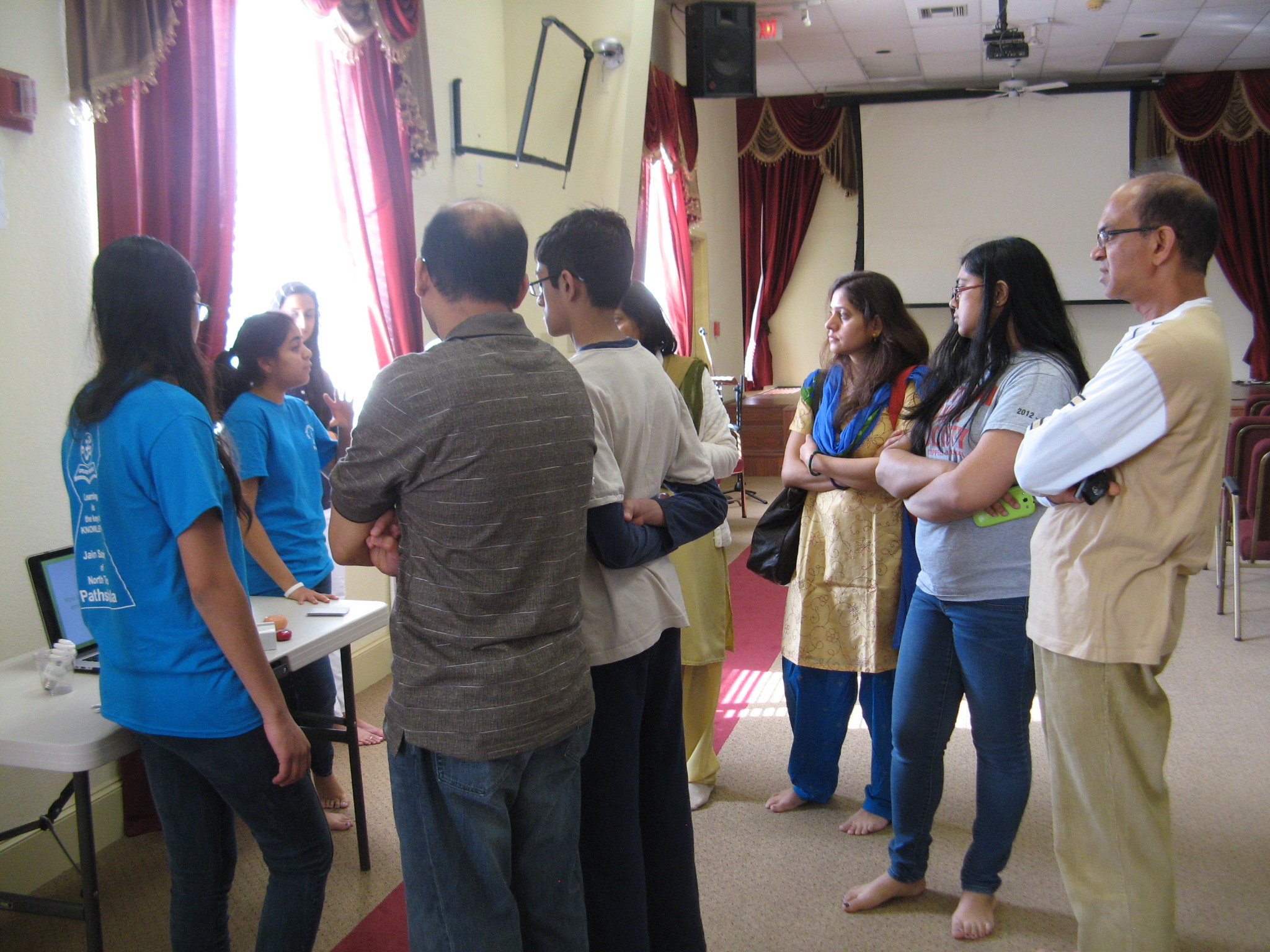
Environmental Fair PosterThe Jain Society of North Texas’ (JSNT) high school  age youth (Pathshala Group 6), with the help of  Joseph R. Otterbine,an  M.S. Applied Environmental Anthropology Candidate  from the University of North Texas, recently held  the JSNT Environmental  Fair. The Fair  brought a Jain lens to bear on  energy and electricity, veganism,  transportation, water usage, and methane production. The youth decided on these topics and researched them thoroughly.  They split into five groups and prepared presentations, visuals, and takeaways (e.g. vegan brownies [yummy!] , pamphlets, fact  sheets, water usage calculator, etc.) for their booths at the fair.
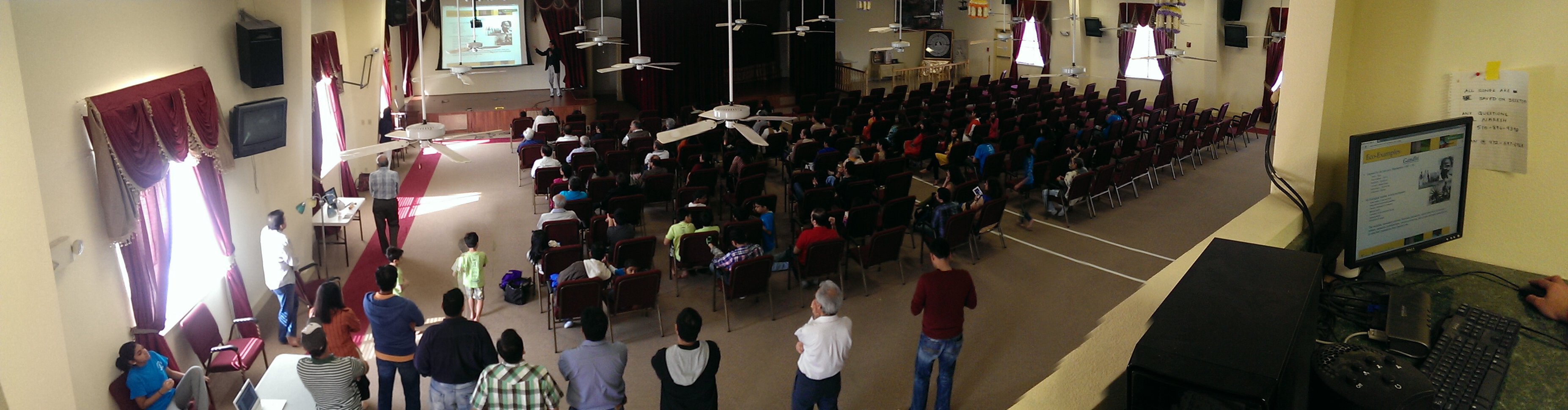
The Fair started with time for the community to walk around and see the booths, followed by a  presentation from Dr. Pankaj Jain (University of North Texas) on the topic of Dharma and  Ecology.

IMAG0038

After his short lecture the community members were urged to visit the five different presentations at the booths set up around the hall. The community was extremely receptive to the
youth’s efforts and proud of all the work that they had done in putting together all the intricacies of the Fair. When it came to the scheduled end of the Fair, some community membewer asked for more time to explore all the work that the youth had done! 

This event was successful because the youth wanted to do it,  and OWNED it!
This enthusiasm was palpable in their presentations, their attitudes, and interactions with the  community. The Fair got the Jain Society of North Texas to look at environmental issues and  how they, as Jains, are poised as natural environmentalists.
For a slide show of the event please see http://www.dfwjains.org/
and  keep reading this post to hear more about about environmentalism and energy use in a state traditionally known for its economic dependence on oil from these amazing Jain students. And for more on veganism, methane and water use, see the next post… Continue reading

THe New Incarnation of Jivdaya: The Ahimsak Eco Vegan Committee of JAINA

In the late 1990s, the Jivdaya committee actively promoted veganism. It was clear that animal sanctuaries, the traditional institutions for Jains to give money in India to express their ahimsa, was not addressing the root of the problem of animal suffering and slaughter. I have posted some of the material from this era on this site.

This year was have a newly approved JAINA committee to represent these views and link them with our growing awareness of environmental choices that we make that can hurt or help animals and other living beings. Dubbed the Ahimsak Eco-Vegan Committee, our objective and goals follow.


Objective

The Ahimsak Eco- Vegan committee, as an expression of ahimsa, support veganism which we understand to mean not eating, wearing, or using animal products, because we object to both animal suffering and animal killing. We do not support animal use that is supposedly “humane” and we do not support the marketing of animal products labeled as “humane”.

The  Ahimsak Eco- Vegan committee, as an expression of ahimsa,  supports the reduction and elimination of activities contributing to harm of all life, global climate change and destruction of the planet.

Goals:

  • Promote local education and implementation of initiatives in support of ahimsak diet (veganism) and lifestyles (eco-friendly and non-use of animal items in clothing or other use)
  • Move towards fully vegan and eco-friendly YJA and JAINA conventions  events
  • Publicize activities and provide global leadership for the Jain lay, scholar and ascetic community toward an ahimsak diet and lifestyle
  • Provide health related education to the community on a plant based diet and conduct research benefitting our community and contributing to scientific knowledge on benefits, risks and risk mitigation of the modern vegetarian and vegan diet as consumed by Jains in North America.