Video

Profiles of Vegan Jains: Pramodaben Chitrabhanu

Pramodaben discusses  how people might make the journey towards veganism, including her own personal experience and how women can encourage their families towards a vegan diet as an expression of wanting the best for them. In the last part she links the experience of mothers to empathy towards  dairy cows. Click on the link to read her more comprehensive booklet: Dark Truth Behind The Milk_19-06-2013.  I will provide updated health information in a future posting but agree completely with the facts of dairy farming and the necessity to avoid consuming dairy products.

Video

Profiles of Vegan Jains: Seema and Amman

Twenty five year old Seema and  23 year old Amman have a conversation about personal histories and how they became vegan.

Video

Profiles of Vegan Jains: Sagar Shah

http://www.youtube.com/watch?v=TM3UtI17Bnw&feature=youtu.be

http://youtu.be/QlnDqsqvLrI

http//youtu.be/fSuOQ_A1pt0

Sagar, who is an economist based in the UK, speaks from Jaipur and Delhi, where he is studying at the International Jain Studies Summer program about  his journey to veganism, the reasons to go vegan and why it is compassionate, not elitist.This is one in a series of videos that we are posting in time to be viewed at the Eco-Vegan booth at the JAINA convention in Detroit over the July 4 weekend. While I thought that the UK Young Jains conventions were vegan first, and was impressed that they were all vegan when I went in 1998, Sagar discusses his learning about veganism at ta US JAINA convention in New Jersey. As with Pramodaben’s story, once he learned about veganism, he found plenty of vegan dairy alternatives in his own backyard.

Mindful Eating Prayer

These Five Contemplations by Thich Nhat Hanh resonate so much with me as a Jain that i wanted to share it on this blog:Image

This food is the gift of the whole universe: the earth, the sky, numerous living beings, and
much hard, loving work.
May we eat with mindfulness and gratitude so as to be worthy to receive it.
May we recognize and transform our unwholesome mental formations, especially our greed,
and learn to eat with moderation.
May we keep our compassion alive by eating in such a way that we reduce the suffering of
living beings, preserve our planet, and reverse the process of global warming.
We accept this food so that we may nurture our sisterhood and brotherhood, strengthen our
community, and nourish our ideal of serving all living beings.

Chitrabhanuji and Thich Nhat Hanh among few vegan spiritual teachers

Dr. Will Tuttle writes here about why so few spiritual teachers are vegan and mentions the two that have influenced us, as the hosts of this blog, the most: Chitrabhanuji, our foremost teacher of Jainism in the US and Thich Nhat Hanh, a Buddhist monk teaching mindfulness with Westerners, Vietnamese and others around the globe.  See our other posts for more about both of these revered teachers and we would like to acknowledge, too, the teaching of Pramodaben Chitrabhanu, who continues spreading the message of veganism among Jains.

We know of the other vegan spiritual teachers that Dr. Tuttle mentions as well: we’ve eaten at the Loving Hut restaurants that Master Ching Hai inspires. We’ve also been amazed by the videos produced in multiple languages with vegan cooking lessons. And Dr. Gabriel Cousens has inspired  friends to run a program to reverse diabetes based on a raw vegan diet based on their experiences at his healing center.
Continue reading

Easy Almond Milk

We’ve been making almond milk from scratch for a few years, soaking the almonds (1 cup), draining, blending with 3 cups water, straining out the pulp, sometimes sweetening with dates or adding vanilla or cardamom. It is always delicious but sometimes felt time consuming.The store bought almond milk seems to have a lot of filler and is not as good. So SURPRISE!

In the book Forks over Knives, companion to the movie that is such a great resource, we found the following: Add 1-2 teaspoons of raw almond butter to each 1 cup of water and blend until smooth. We happen to have roasted almond butter on hand and it tasted good but will try raw next, because it will surely be even better. What a find! No worries about wasting or saving the pulp and we can make a small amount at a time.

Interestingly the website detoxinista.com has detailed instructions on making your own almond butter using a food processor. Lately we have been using the food processor to make our own almond butter. Living in California we can go to the local farmer’s market and buy organic almonds straight from the farmer. So from almonds to almond butter to almond milk, no added filler!

Valuing Life

Today I happened to turn on public television to a documentary about  farming in California.

Being immersed in a micro-culture with many friends that oppose GMO, factory farming and chemical pesticides,  I was surprised to hear the host express how great is it that we have chemical fertilizers that improve productivity of crops, that we have established a way to fatten up cows fast to feed the global appetite for beef, etc. I think eventually the tone changed, but he was eating beef while discussing animal agriculture. Having travelled to India and other poor countries and knowing about the poverty even in what is called food deserts in the US, I was appalled that the show featured a town in which CA surplus tomatos were thrown around in a food fight that was framed as a cancer benefit. People paid $10 a person to throw tomatos at each other. Even if there was a cause behind it, it seemed obscene to be wasting plant life like that. And then the show cut to a slaughterhouse scene– as if it were all OK!

Next show was “Half the Sky”. There was plenty to be inspired by,but there was unspeakable violence to women depicted in Sierra Leone, India, Cambodia and Kenya, among other countries. Women raped, beaten, sold to be prostituted and killed. (There are parallels to the way that dairy cows are treated, which we could well consider in terms of karmic consequences). Economic opportunities, education and health care provide a way out, but there are tremendous violent forces that profit from women’s pain.  The message of the documentary is that things can change, if we all  contribute our energy, in some way.

As people that believe in the value of all life, (as vegans, as Jains)  do we really live our principles? Do we  treat the smallest sentient being with care? Do we consciously avoid eating products of violence of 5 sensed beings? Do we respect and encourage girls and women to their highest spiritual evolution?

Or are we stuck mindlessly reproducing cultural patterns that numb us and devalue life?  We might be vegetarian, but don’t want to think beyond that and become vegan. We might avoid killing the insects, but drive an SUV. We might want our daughter to get educated but we tell her that according to the Digambars, women cannot be liberated. Are we living and giving to the world the values that we profess?

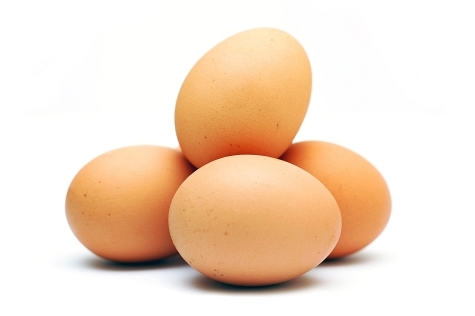
Special re-post for Paryushan: Are eggs vegetarian?

Sagar Kirit Shah, an economist from London, reflects on his experiences with eating eggs and argues why vegetarians who do not wish to kill animals should not eat eggs.

Image

The question of whether eggs are suitable for vegetarians is one which most vegetarians living in the UK will have encountered at one point in their lives.  And from the perspective of a young person of an Indian cultural heritage, it is a very confusing one.  In India, the norm is that eggs are not vegetarian – if you see the words “pure veg” on an Indian product or at an Indian restaurant, you can generally be sure that there will be no eggs.  But in the UK, the official definition of a vegetarian, as set out by theVegetarian Society, permits the consumption of eggs.  As a result, products containing eggs are normally labelled as vegetarian in supermarkets and restaurants in the UK, to the dismay of many Indian vegetarians.

Even though I’ve been a proud “vegetarian” for as long as I can remember, I’ve been confused about what I think about eggs for most of my life, and have switched between shamelessly enjoying them and trying to avoid them.  I think many young people from the Jain community in the West have faced a similar internal conflict.  Having carefully considered the issue, I now believe that those of us who are vegetarian because we think it is wrong to kill animals for food should not eat eggs, regardless of whether the eggs are free range and/or organic.  In this article, I share my experiences of eating eggs and explain why I adopt the position that I do.


Continue reading

Happy 90th Birthday Gurudev Chitrabhanu

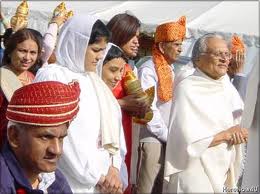
Today is the 90th birthday of one of the two Jain monks that brought Jainism to America. Gurudev has been instrumental in creating the environment that enabled Jains from India, such as my parents, their children born in the US, such as me, and Americans interested in Jainism, such as friends at the Jain Meditation International and Lighthouse Centers, to understand and practice this ancient  tradition with its timeless principle of ahimsa.

He is pictured  on the far right at one of the Pratishtas ( temple openings) that he attended.

Image

Gurudev Chitrabhanu came to the US in 1971. I was one year old. As he travelled and authored books, founded Jain Meditation International and spoke to audiences, my parents and their friends founded the Jain Society of Chicago. He helped organize the association of Jain associations  called JAINA.   He wrote books prolifically, and my  mother bought them, kept them in our temple and as she prayed, I read them voraciously.   I grew up reading “Inspiring Anecdotes”, ” A Lotus Blooms” and later, his books about Jain meditation. I heard Gurudev speak at Jain centers and JAINA conferences. And then when I was 20, I went to Siddhachalam, the Jain ashram founded by Acharya Sushilmuniji, the other Jain monk that brought Jainism to America. I became vegan after attending a New Jersey Animal Rights Alliance Conference there. As I, along with  a cohort of Jains in my generation, went vegan, we were reassured that Gurudev and Pramodaben understood and promoted veganism, or pure vegetarianism to our Jain community. They have spoken about the need to remove dairy products from our rituals and our diets, eloquently and persistently.

There has been a remarkable resistance to giving up dairy. Some Jains argue that veganism is a religion separate from Jainism and that Mahavir was not vegan. Despite criticism, Gurudev, with the spiritual understanding borne of 5 years of silence with monks’ vows and a lifetime of practice, maintains the clarity of his message: Ahimsa Paramo Dharma. Non-violence is the supreme religion. Veganism is but one expression. One cannot consume milk and consider oneself a pure vegetarian, practicing ahimsa.

And his reply, as Pravin K. Shah wrote recently, to the question of how to respond to people that oppose veganism, continues to inspire me. These are lines from the song that he authored  Maitri Bhavana Pavitra Zharanu :

May I always be there to show the path  

To the pathless wanderers of life

Yet, if they should not hearken to me,

May I bide in patience.

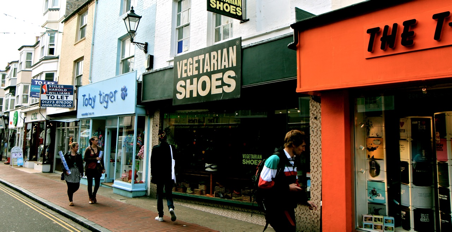
Is it time for Jains to give leather the boot?

This post is contributed by Sagar Kirit Shah,   member of the Jain Vegans in the UK.


In a world dominated by greed and materialism, the Jain community are leaders when it comes to demonstrating how to live a peaceful, low himsa lifestyle.  For thousands of years, Jains have followed a strict vegetarian diet and lived in harmony with nature.  And Jain monks and nuns illustrate how it is possible to live an empowering and fulfilling life without material possessions.

Jains in the West continue to try to live by traditional principles.  We try to lead modest lifestyles and participate in charitable activities when we can. We steer clear of activities and professions that involve violence or exploitation of other humans and animals.  Despite being confronted with a variety of temptations, large numbers of us have continued to follow a strict vegetarian diet.

While I’m tremendously proud of the example set by members of our community, I’ve always found it very difficult to understand why Jains, Hindus and other vegetarians seem to find it acceptable to wear leather.   As a young child, I often used to ask my mum why it was wrong to kill cows to eat them, yet acceptable to kill them for clothing.   My mum would explain to me that leather was taken from cows that were already dead. Continue reading