Is it time for Jains to give leather the boot?

This post is contributed by Sagar Kirit Shah,   member of the Jain Vegans in the UK.


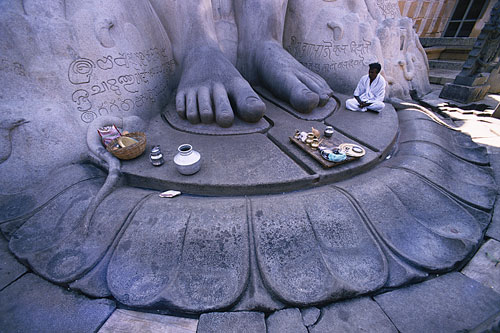
In a world dominated by greed and materialism, the Jain community are leaders when it comes to demonstrating how to live a peaceful, low himsa lifestyle.  For thousands of years, Jains have followed a strict vegetarian diet and lived in harmony with nature.  And Jain monks and nuns illustrate how it is possible to live an empowering and fulfilling life without material possessions.

Jains in the West continue to try to live by traditional principles.  We try to lead modest lifestyles and participate in charitable activities when we can. We steer clear of activities and professions that involve violence or exploitation of other humans and animals.  Despite being confronted with a variety of temptations, large numbers of us have continued to follow a strict vegetarian diet.

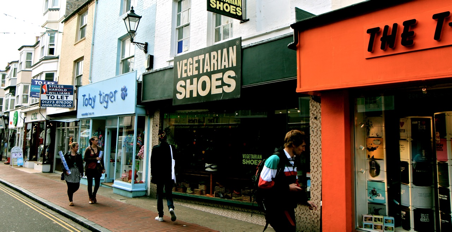
While I’m tremendously proud of the example set by members of our community, I’ve always found it very difficult to understand why Jains, Hindus and other vegetarians seem to find it acceptable to wear leather.   As a young child, I often used to ask my mum why it was wrong to kill cows to eat them, yet acceptable to kill them for clothing.   My mum would explain to me that leather was taken from cows that were already dead. Continue reading

Video

True Health and Beauty Arise from Compassion

Ajahn Guna of Berkeley Buddhist Monastery discusses how good health and beauty are not commodities but the consequences of generosity, compassion and virtue. Next to him is the producer of the documentary “Got the Facts on Milk?”, an informative and provocative film that we watched and discussed with a break for mindful walking, allowing for people to process the information they received with a fresh state of mind.

Lower Your Himsa Footprint

This thoughtful post is contributed by Mahersh Shah and the Jain Vegans Team, which moderates a web forum that is separate and complementary to this blog. I (drJina) was struck by the appropriateness of the term himsa footprint when I saw this term discussed in the web forum, and Mahersh graciously agreed to write more about it for our blog. Here’s his piece:

Most of us are familiar with the current-day concepts of “eco-footprint” and “carbon footprint” – these terms and concepts have become part of our everyday vocabulary and thought processes.Today, we are being encouraged to reduce our carbon footprints (to help slow down, if not reverse, human-induced global warming and climate change), and to minimise our eco-footprints in a bid to reduce our destructive impact on the environment.

At a Young Jains UK event in  Feb 2008 that started as a conversation about why a vegan rather than vegetarian diet would be consistent with Jain values with  keynote speaker and longtime US based vegan Saurabh Dalal,  the term himsa footprint spontaneously emerged.  The group that was to become the Jain Vegans team  discussed ahimsa and eco-footprints as a reason for going vegan.  Very soon, Kewal Shah shouted out the phrase himsa footprint as it simply appeared in his mind, and the Jain vegans have been using it extensively since.

So how does the term himsa footprint help us?  Well, the beauty of this neat and powerful expression is that it speaks volumes.  To me, when we talk about “lowering our himsa footprints”, we are speaking in a holistic sense, covering the direct and indirect himsa inflicted, by our actions, on all life around us. And by extension, this includes himsa on the environment, since harming or destroying life damages the environment, and damaging the environment harms or destroys life.  Thus, to me, the general concept of himsa footprint covers the more specific concepts of eco-footprint and carbon-footprint, for example, as well as many others.
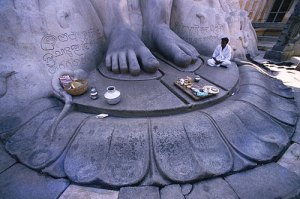
Jains have a long and prominent tradition of embracing ahimsa (non-violence, compassion, peace).  In fact, the concept of ahimsa is at the very core of the Jain lifestyle.  For Jains, and others who believe in karma, practicing ahimsa is also a way of developing spiritually and purifying one’s atma (soul).  Therefore, lowering one’s himsa footprint would be an important activity for a Jain from a karmic standpoint too.  But even if one doesn’t believe in karma, leading life so as to consciously reduce one’s himsa footprint would surely bring about positive inner development, as well as benefiting all life and the environment around us.

Perhaps if we all begin to think in holistic terms of consciously and actively reducing our himsa footprints, then we’ll see many of the global issues facing us today being addressed in one go (e.g. human-induced climate change and other environmental issues).  Indeed, if most human societies, policy-makers and governments around the world started thinking in terms of himsa footprints, then we might even see a dramatic reduction in human-human conflict, bloodshed, war, abuses of human rights and animal rights, poverty, starvation and so on.

Continue reading

Thanksgiving Reflections

Last year, I posted a Vegan Thanksgiving Prayer. This year, I came across a post on another blog, Happy Healthy Long Life, which is all about gratitude for the wonderful things and people in our lives. In Jainism we are very careful not to harm and our rituals seem to emphasize beneficial regret and asking forgiveness.  My Thanksgiving prayer typifies our Jain sensibility. In a complementary way, gratitude can bring a positive aspect to our care for other beings.

Incidentally, the writer of Happy Healthy Long Life has a scientific and health focus, but recently she wrote about how it felt to learn about the way that dairy cows were treated. I found it refreshing that she discussed the compassion aspect of a diet that she found initially for health reasons.

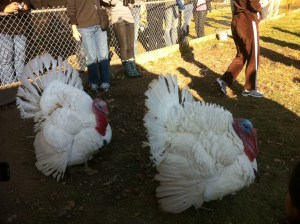
Farm Sanctuary has a live stream on Thanksgiving of rescued turkeys at their New York Sanctuary (go to farmsanctuary.org from 9am to 4pm). Turkeys are surprisingly cute and friendly as we found out last week when we visited Harvest Home Sanctuary.

I am grateful, dear readers, that you chose to read this blog and that i have a venue for expressing these thoughts. May your holiday be full of joy and compassion.

Have a very happy Thanksgiving.

Harvest Home Sanctuary’s Toast for the Turkeys Thanksgiving celebration

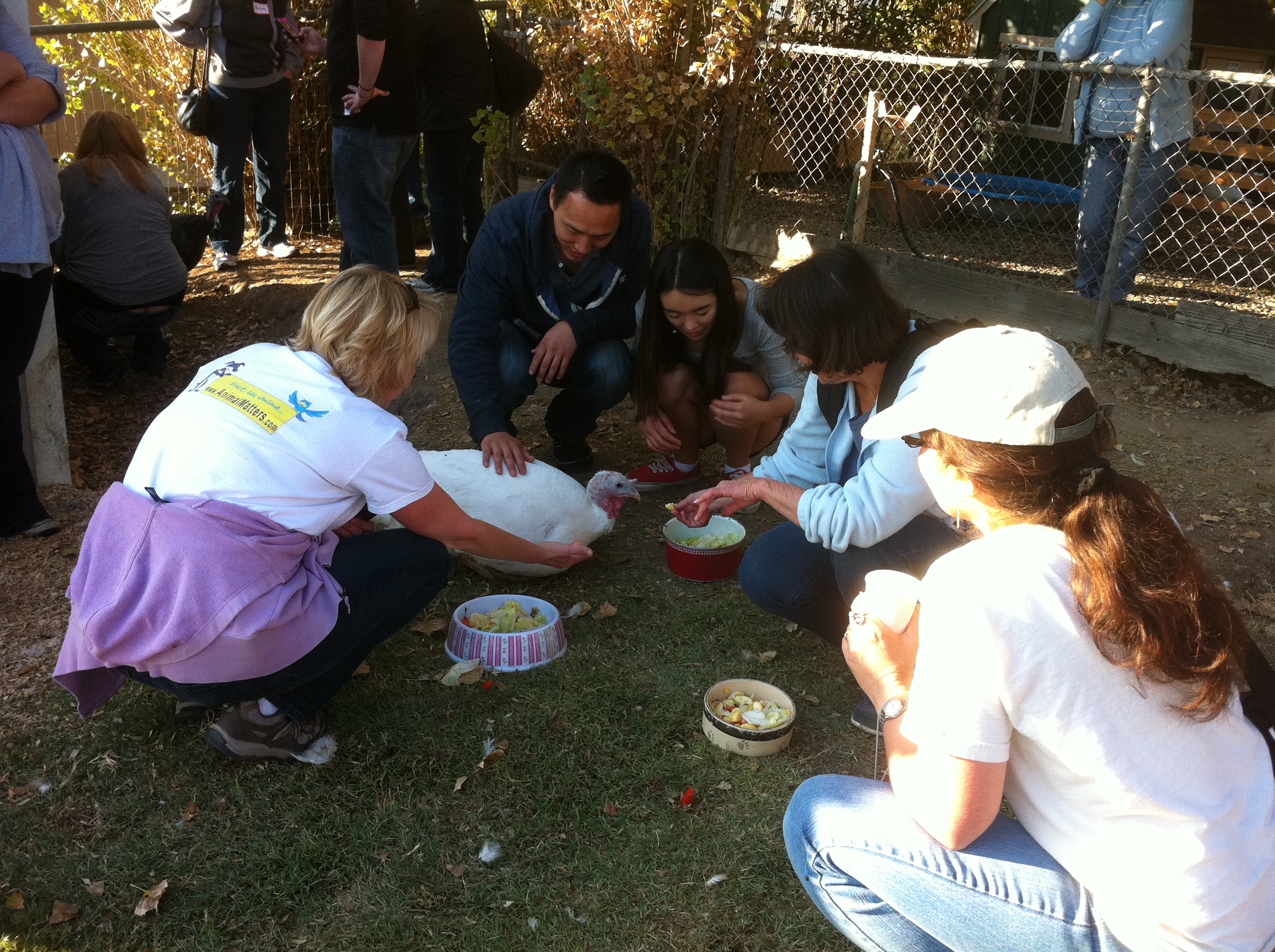
Today we fed turkeys and goats, played with dogs and rabbits and learned about the animals that are rescued and supported at Harvest Home Sanctuary. It was Harvest Home Sanctuary‘s Toast for  the Turkeys event.

It felt like  American version of the Jain panjrapol (our traditional animal shelters in India),  with activities that  transformed a very American holiday 0f suffering for turkeys into ahimsa for animals .


Please consider supporting Harvest Home Sanctuary or Farm Sanctuary, with shelters in CA and NY, by sponsoring a turkey and/or supporting the shelter animals year round. Visit these shelters! You will be touched by the animals and the humans that care for them.

A Diwali gift from PCRM: Vegan Kickstart for India!

OK, PCRM didn’t really time this for Diwali, our holiday celebrating the Nirvana of Mahavir Swami Tirthankar this Wednesday. But how nice that we have a 21 day program complete with Indian menus and a Kickstart program set for early November! Spread the word and check it out here.

Dr. Barnard gave a very nice, positive talk at JAINA last July which we have been meaning to post up.  One point that he made very well is how tastes can change;  many of the uncles and antis could identify with the way they are now able to enjoy fat free or low fat milk, when they used to like only full fat milk; similarly, tastes can change to enjoy even healthier soy, almond, rice and other types of non-dairy milks.

For those who follow a traditional Jain diet, the recipes on the Kickstart menu can be easily modified to eliminate root vegetables.  Just remember the 5 sensed beings that are harmed in our traditional dairy based diet and consider all the compassion you are showing by sparing the cows that suffering!

Happy Diwali, may the light of knowledge guide us towards enlightened action.

On the Plight of Cows in India- our fond memories of the Indian family cow are outdated

My friend Dr. Tushar, a family doctor in Canada,  organizes a wonderful volunteer opportunity to teach school children about health issues in rural Gujarat, as part of the Bidada health camp. He recently reached out with an email regarding the plight of Indian cows.
I volunteered with him in 2008 and remember visiting a panjra-pol at that time, and talked with the caretaker who informed me sadly that the capacity of the panjra-pol was limited, and that ultimately many of the cows had to be sold to slaughter.
Dr. Tushar’s post  follows:
 India has the highest population of cows in the world, over 280 million (or 28 crores).  This is a massive number.  Now here are a few facts.  A cow in India can live for around 23 years.  She starts producing milk at the age of around 4, and milk production lowers down at the age of around 12.  Each year, as our slave, she must be forced to become pregnant and have a baby, which is taken away by force.  Most cows are now brought up in very crowded conditions, and the percentage in humane conditions is becoming the exception rather than the norm.  These cramped places are out of the public eye, because businesses do not want people to see what goes on there.


Prof Gary Francione’s talk at JAINA 2011

Here are the links for the first few segments of Prof. Francione’s discussion of veganism and ahimsa at JAINA.
Part 1

Part 2

Part 3

Confusing Vegan and Environmental Messages at JAINA 2011

Despite the support of many Jain leaders and JAINA convention attendees, there was no clear response to our call for on all vegan menu. At one point, we heard there would be one all vegan day, then a few all vegan meals. An email came out to all attendees prior to the convention regarding the need to sign up for vegan meals, and letting them know to register. I emailed back to suggest that since they had invited vegan speakers, and people may be convinced to try vegan items, to have some excess capacity. But there was no reply, and at the actual event, several people who were persuaded by talks such as Prof Gary Francione’s, and Dr. Neal Barnard’s were turned away from the vegan line. Unfortunately, for those of us who did sign up before the convention, it was difficult  to ascertain what was vegan even in the vegan lines.The volunteers had a lot to handle at this convention and this is not intended to downplay their efforts, but it was very disappointing that they didn’t know what was vegan, and I think the the convention leaders could have been more clear,so that the meals and the message of the talks could have been consistent.
Another disappointing vision was the ubiquity of plastic water bottles, which, even if recycled, create unnecessary environmental resource use, and in many cases were not recycled. Also, as seems to be the norm for JAIN events, there was  egregious use of styrofoam plates with a milk compartment used to serve meals(as pictured on a previous post here about the Jain Center of GA). If we as a community are doing so well financially and hold ahimsa so dear to our ideals, why can’t we figure out a way to replace styrofoam with washable or at least compostable or biodegradable alternatives?

We did appreciate the efforts of Asha Jain to make the meals healthier and all the volunteers’ work. We certainly did not leave hungry or thirsty. Bringing our own water bottles and food containers to the conventions, we participated in the events, without generating so much waste (washing our plates with Dr. Bronner’s soap in the hotel room and reused them for each meal). We met friends and family and had a nice time at the convention.
We will post some of the talks on this site this week to inspire or reinspire our readers!

Paryushan Activism:Join Animal sanctuary volunteers and Bay area Jains to oppose backyard slaughter of animals

Harvest Home Bake Sale

One Saturday morning, I wandered towards my local farmer’s market and was happy to see a vegan bake sale to supply me with goodies for my friends and family and support the Harvest Home Sanctuary, which rescues animals, at the same time.

That Saturday, as  I continued to shop in my market, I noticed that in addition to the numerous stalls  filled with fresh fruits and vegetables,  bread and other treats, there were a disturbing few stalls of of raw milk and local meat on sale. And then I circled back to the Harvest Home volunteers to chat some more.

As I got to know these lovely volunteers, they informed me that where I live, in Oakland, CA the planning commission has initiated a plan to make slaughter of animals in residential neighborhoods legal, as part of a plan to encourage healthy local eating.  While many vegetarians and vegan fully support efforts to grow plants, we are opposed to allowing animals to be killed, for the sake of our own family’s exposure to slaughter and because we’d rather not have an sanctioned, legal,   killing of animals  in our neighborhood.  For more details on the initiative go to noslaughter.org. To sign the petition directly, click here (note there is an option not to display your signature publicly in order to maintain your privacy). Besides Oakland, other cities around the country are watching and if this passes, you could have the same problem where you live, so make your voice heard!

As Jains we have a tradition of opposing the building of slaughterhouses. In recent times, one of our sadhus was imprisoned in U.P. Our opposition to backyard killing is consistent with our peaceful tradition of activism. Now all your paryushan activitism requires is a click and some typing on your computer.

Read on for more background….

Continue reading